Death of Iran’s Supreme Leader (1939–2026)
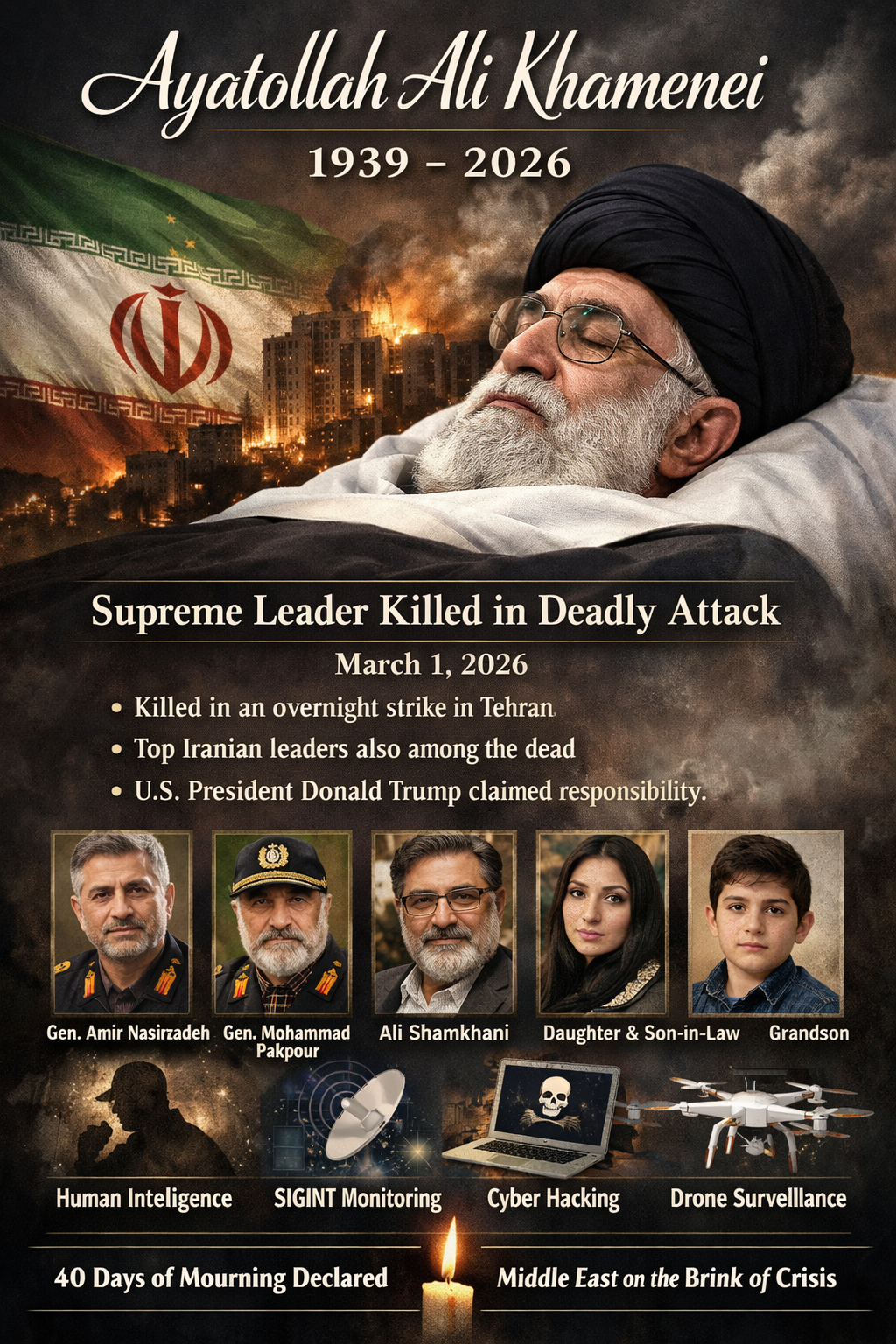
The reported death of Ali Khamenei, the Supreme Leader of Iran, on March 1, 2026, has shaken the political landscape of the Middle East and drawn global attention. According to various reports, a powerful and highly coordinated attack occurred in the Iranian capital Tehran late at night, creating panic and uncertainty across the country.
At 12:37 AM, former U.S. President Donald Trump reportedly claimed that the Iranian Supreme Leader had died in the strike. Initially, Iranian officials and state media remained silent, which led to widespread speculation across international media platforms. Later, Iranian authorities reportedly confirmed that the Supreme Leader had been killed during the attack.
Senior Officials Reportedly Killed in the Attack
According to Iranian media and several international reports, the attack also resulted in the deaths of several high-ranking Iranian officials. Among those mentioned were:
- Amir Nasirzadeh — Iran’s Minister of Defense
- Mohammad Pakpour — Commander of the Islamic Revolutionary Guard Corps
- Ali Shamkhani — Senior adviser to the Supreme Leader and former Secretary of Iran’s Supreme National Security Council
Some reports also suggested that a few members of Khamenei’s family were present during the attack and were among the casualties. These reportedly included a daughter, son-in-law, daughter-in-law, and a grandchild, although official confirmation regarding family members has remained limited.
National Mourning and Security Situation
Following the incident, the Iranian government declared 40 days of national mourning and announced seven days of public holidays across the country. The Islamic Revolutionary Guard Corps (IRGC) vowed to respond strongly to the attack and promised retaliation against those responsible.
Security measures were immediately tightened in major cities, especially in Tehran. Military checkpoints were increased, and many sensitive government buildings were placed under strict protection. Reports indicated that the atmosphere among the public was tense, with many citizens worried about possible regional conflict or instability.
International Reaction
The international response to the incident was swift and cautious.
- Governments in Russia and China reportedly issued condolence messages and called for restraint in the region.
- Several Western countries and U.S. allies expressed concern that the situation could escalate into a broader geopolitical crisis.
- Global energy markets reacted quickly, with oil prices rising due to fears that tensions around the Strait of Hormuz could disrupt global oil supply routes.
Political analysts around the world warned that the death of Iran’s Supreme Leader could mark a major turning point in Middle Eastern geopolitics and might trigger new power struggles within Iran’s leadership structure.
Possible Intelligence Leak Behind the Attack
Although no official explanation has yet been confirmed, defense experts have discussed several possible intelligence scenarios that could have made such a targeted attack possible:
Human Intelligence (HUMINT):
Information might have been leaked by insiders who had knowledge of the Supreme Leader’s movements, schedule, or security arrangements.
Signals Intelligence (SIGINT):
Communication signals from mobile phones, satellite communications, or radio transmissions could have been intercepted and tracked.
Cyber Espionage:
Hackers might have gained access to Iranian surveillance systems, security cameras, or communication networks.
Satellite and Drone Surveillance:
Advanced satellite imagery or drone monitoring could have been used to track the location and confirm the results of the attack.
Multi-Layer Intelligence Operations:
Experts believe the attack may have relied on a combination of human sources, cyber intelligence, satellite monitoring, and electronic surveillance.
These possibilities suggest that the operation may have been highly sophisticated and carefully coordinated.
Life, Struggle, and Leadership of Ali Khamenei
Ali Khamenei was born in 1939 in the city of Mashhad, one of Iran’s most important religious centers. He studied Islamic theology in the religious seminaries of Qom, where he became involved in the revolutionary movement led by Ruhollah Khomeini against the rule of the Shah.
During the years leading up to the Iranian Revolution of 1979, Khamenei was arrested multiple times and spent periods in prison because of his political activism. After the revolution succeeded, he quickly rose within the new Islamic government.
In 1981, he survived a serious assassination attempt during a public speech when a bomb exploded near him. The attack severely injured his right arm, leaving it permanently paralyzed. Because he survived the attempt, many supporters later referred to him as a “living martyr.”
Later that same year, he was elected President of Iran and served two terms from 1981 to 1989. After the death of Ruhollah Khomeini in 1989, Khamenei was selected by Iran’s Assembly of Experts to become the Supreme Leader of Iran, the most powerful position in the country’s political system.
For nearly 36 years, he remained the ultimate authority over Iran’s government, military forces, judiciary, and key national policies. His leadership period included major geopolitical tensions, including disputes with the United States, debates over Iran’s nuclear program, regional conflicts, and internal political challenges.
Dr, Amanullah.
Leave a Reply